
Sagrada Família After the Opening of the Tower of Jesus Christ in 2026: What Changed for Tourists
The year 2026 marked one of the most important stages in the long history of Barcelona’s Sagrada Família. On 20 February, the final upper section of the cross was installed on the Tower of Jesus Christ, bringing the basilica to its planned maximum height of 172.5 metres. The tower was formally blessed and inaugurated on 10 June, exactly one hundred years after the death of Antoni Gaudí. For tourists, however, the meaning of this milestone needs some clarification. The inauguration did not turn the Tower of Jesus Christ into a new observation tower that ordinary ticket holders can enter. Its main effect is architectural and visual: visitors can now see Gaudí’s central composition at its intended height, crowned by a 17-metre cross. At the same time, construction elsewhere at the Sagrada Família continues, so a visit in 2026 combines a historic completed element with an active building project that is still evolving.
The 2026 Tower Milestone and What Visitors Actually See
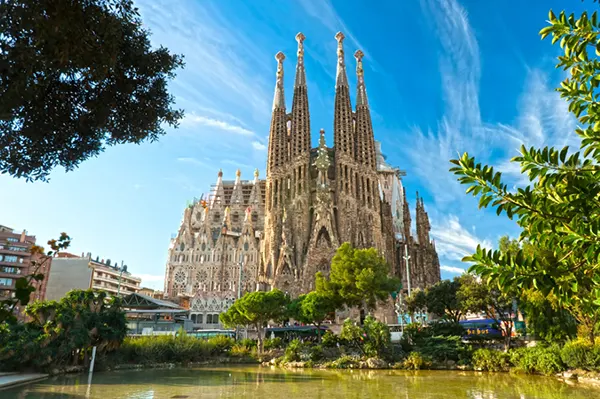
The most visible change is the completed skyline of the central part of the Sagrada Família. The Tower of Jesus Christ rises to 172.5 metres, making it the highest point of the basilica and giving the building the vertical hierarchy planned for the central group of towers. Its final element is a four-armed cross measuring approximately 17 metres in height and 13.5 metres in width. The exterior uses white enamelled ceramic and glass, materials chosen partly for the way they interact with light. Once the upper arm of the cross was put into position on 20 February 2026, work on the exterior of the central tower was officially considered complete. The resulting height also places the Sagrada Família above other historic churches in terms of overall elevation, and it is now widely recognised as the tallest church in the world.
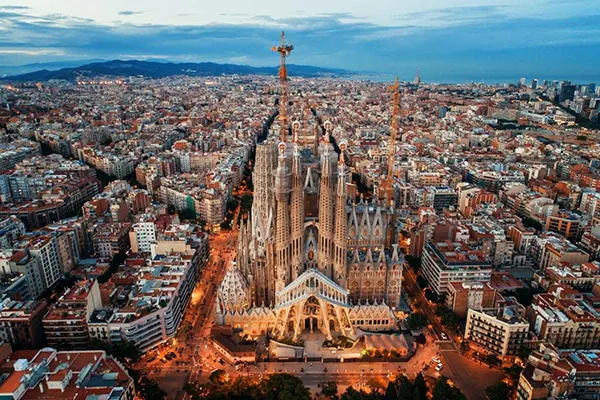
The second major date was 10 June 2026. Pope Leo XIV presided over a solemn Mass at the Sagrada Família and blessed the new tower during its formal inauguration. The date had particular significance because Antoni Gaudí died on 10 June 1926. After the ceremony, the Tower of Jesus Christ was illuminated for the first time, adding another visual element to the completed central structure. This event turned the tower from a construction milestone into a formally inaugurated part of the basilica. Tourists arriving after June therefore see a monument with a substantially different upper profile from the one photographed only a few years earlier. The cross now provides a clear finishing point to the central tower and can be seen from many surrounding streets as well as from more distant parts of Barcelona.
It is equally important to understand what did not happen in 2026. Completion of the exterior of the Tower of Jesus Christ did not mean completion of the entire Sagrada Família. Work remains under way in other parts of the building, including the Glory façade and its towers. Interior work associated with the central tower is also expected to continue beyond 2026. In July, the construction team began lowering the main central crane because it was no longer required at its previous height. The crane is now intended primarily to support work on the towers of the Glory façade. Visitors should therefore not expect a completely crane-free or construction-free monument. What has changed is the focus of the work: the tallest central element has reached its finished exterior form, while construction activity is gradually moving towards other sections of the basilica.
Why the New Tower Changes the Sagrada Família Skyline
The Tower of Jesus Christ has a role that goes beyond simply making the building taller. Gaudí designed the basilica as a group of towers with different symbolic importance, and the central tower was always intended to dominate them. The four towers of the Evangelists stand around it, while the Tower of the Virgin Mary forms another important element of the central arrangement. Before the Tower of Jesus Christ reached its full height, visitors could understand this hierarchy from models and architectural drawings, but the skyline itself was incomplete. In 2026, that relationship became much clearer from ground level. Looking towards the basilica from neighbouring streets, the eye is now naturally drawn towards the large cross at the centre rather than towards one of the surrounding towers or a temporary construction structure.
This difference is particularly relevant to visitors interested in photography. Older photographs of the Sagrada Família often show the central tower surrounded by scaffolding, cranes or unfinished upper sections. The 2026 version has a recognisable final summit, which changes both close-range photographs and wider views of the Barcelona skyline. Plaça de Gaudí and streets around the basilica remain useful locations for seeing the relationship between the façades and the new central height, while longer views give a clearer impression of how far the Tower of Jesus Christ rises above surrounding buildings. The visual result varies considerably with distance: from directly beside the basilica, its scale can make the highest sections difficult to take in at once, whereas a more distant position makes the hierarchy of the towers easier to understand.
The cross itself also affects how the building appears under changing light. Its glass and white ceramic surfaces were designed to make the upper structure stand out rather than disappear into the stonework below. This is particularly noticeable when sunlight reaches the lighter surfaces around the summit. The ceremonial illumination on 10 June also demonstrated how the completed tower can become a distinct part of the basilica’s appearance after dark. Visitors should not assume that every special lighting effect used during the inauguration is a permanent nightly attraction, as lighting programmes can depend on events and current arrangements. The lasting change is simpler: the Sagrada Família now has the central cross and full height that had been missing from its silhouette throughout the building’s previous history.
What Has Changed for Tickets, Tower Visits and Access
The most important practical point for tourists is that the inauguration of the Tower of Jesus Christ should not be confused with the opening of that tower to ordinary visitors. As of 2026, the official tower ticket continues to offer access to a tower on either the Nativity façade or the Passion façade. The Tower of Jesus Christ is not listed as one of the public tower choices. This distinction matters because travellers may see references to the tower being “opened” or “inaugurated” and reasonably assume that they can buy a ticket to its summit. At present, that is not the case. The 2026 event was an architectural, religious and ceremonial inauguration. Visitors can see the completed tower from outside and learn about the central towers during their visit, but purchasing a tower ticket does not provide physical access to the Tower of Jesus Christ.
Current official prices also make the distinction clear. In 2026, standard admission to the Sagrada Família costs €26 for a general adult ticket and includes access to the basilica and museum, together with the official app and downloadable audioguide. It does not include a tower visit or access to the crypt. The ticket that combines the basilica with one of the publicly accessible towers costs €36 for general admission. A guided visit with tower access is listed at €40, while a guided visit without the tower is available separately. These prices can change, so travellers planning several months ahead should check the official ticket information before paying. Tickets are linked to a specific date and entry time, and visitors may be required to show official photographic identification corresponding to the booking.
The practical rules for the Nativity and Passion towers remain more important to most tourists than the ceremonial status of the new central tower. Visitors use a lift to go up and descend on foot, so the tower visit involves stairs even though the ascent is assisted. Children under six are not permitted in the towers, while visitors between six and sixteen must be accompanied by an adult. Tower access is not adapted for people with reduced mobility or certain functional accessibility requirements, and bags or rucksacks must be left in the lockers provided before going up. These restrictions make the basic basilica ticket a more suitable option for some visitors. The main interior of the Sagrada Família itself is accessible to people with reduced mobility, so the inability to visit a tower does not prevent a visit to the principal church spaces.
How to Plan a 2026 Visit Without Expecting Access to the Jesus Tower
A sensible way to choose a ticket is to separate two different aims: seeing the completed Tower of Jesus Christ and getting an elevated view over Barcelona. Anyone entering the basilica can appreciate the architectural relationship between the central tower and the rest of the building, while the exterior can be seen without purchasing the more expensive tower option. Travellers who specifically want to go up a tower should choose between the Nativity and Passion sides according to availability and the direction of the city view they prefer. The Nativity tower looks towards the eastern side of Barcelona, while the Passion tower provides views towards the city centre. Neither option takes visitors into the summit of the new Tower of Jesus Christ, so paying the additional tower charge solely for that purpose would lead to the wrong expectation.
The official digital material partly compensates for areas that cannot be entered. The Sagrada Família app includes the audioguide, and the current tower product also includes digital material dealing with the central towers. This gives visitors additional context for parts of the building that they can see but cannot physically access. It is worth downloading the app before arriving and bringing earphones and a sufficiently charged phone. The standard audioguide is approximately 45 minutes, with a shorter version also available. A basic basilica visit is generally presented as taking around an hour, while the visit including one of the accessible towers is estimated at about an hour and a half. In practice, visitors interested in the museum, façades and architectural details may want to allow longer rather than treating these estimates as strict limits.
Booking ahead remains advisable because entrance is organised by time slot and additional services are subject to availability. Arriving at the correct time is important: the ticket cannot simply be used at another hour or on another day because a visitor’s plans have changed. Security checks also take place at the entrance. Tower operations can be affected by safety conditions or temporary restrictions, and areas available to tourists may occasionally change while construction or church activities are taking place. For this reason, a 2026 visit is better planned around the basilica itself, with tower access treated as an additional part of the day rather than the only reason for going. The completed Tower of Jesus Christ is visible regardless of whether a visitor chooses the basic admission, guided visit or one of the tower packages.
What the Opening Means for the Tourist Experience in Barcelona
The significance of the 2026 inauguration is primarily that tourists are now seeing the Sagrada Família at a different historical stage. For decades, a visit involved looking at Gaudí’s design while imagining how its most important central tower would eventually appear. That is no longer necessary. The highest part of the design is physically present, and the connection between the central group of towers is easier to understand from both inside and outside the basilica. The fact that this happened during the centenary of Gaudí’s death gives visits in 2026 additional historical context. At the same time, describing the Sagrada Família simply as “finished” would be misleading. The completed exterior of the Tower of Jesus Christ is a major achievement, but other parts of the wider architectural project still require years of work.
Construction around the Glory façade is the clearest reminder of this continuing process. After completing the exterior of the Tower of Jesus Christ, the building team began adapting the central crane for a new phase of work. In July 2026, the crane was being reduced to a height of 174 metres and redirected mainly towards construction of the Glory façade towers, which are planned to reach 120 metres. For tourists, this means that cranes and building activity remain part of the Sagrada Família environment even after the highly publicised central-tower inauguration. Temporary changes to viewing areas or visitor routes are therefore still possible. Rather than reducing the value of a visit, this gives travellers a chance to see the basilica during another identifiable stage in a construction history that began in 1882.
The 2026 commemorative programme also means that visitors should pay attention to the basilica’s calendar rather than assuming every day follows exactly the same routine. Religious services, concerts, commemorations and other events can affect access or the atmosphere inside the church. The centenary year has given particular prominence to Gaudí’s life and to the history of the construction, making the museum and interpretive material more relevant for visitors who want context rather than only photographs. It is also worth remembering that the Sagrada Família remains an active place of worship. Appropriate clothing, respectful behaviour and observance of instructions inside the building are expected. From 9:00 to 10:00, the basilica also operates a quiet hour during which visitors are asked to keep noise to a minimum and use earphones with personal devices.
What Tourists Should Take Away from the 2026 Change
For most tourists, the biggest change is not a new room, lift or observation deck. It is the ability to see the central idea of the Sagrada Família much closer to the form Gaudí intended. The Tower of Jesus Christ now provides a fixed highest point above the Evangelist towers and the Tower of the Virgin Mary, while its cross gives the basilica a clearly defined summit. That changes photographs, distant views and the way the whole building can be interpreted from street level. Visitors who last came to Barcelona several years ago will therefore encounter a noticeably different silhouette, even if their route through the interior is broadly familiar. This makes 2026 an important year to revisit the basilica, but the reason is architectural change rather than the addition of public access to the new tower.
The practical visitor routine remains relatively straightforward. Book a timed admission, decide whether a Nativity or Passion tower visit is worth the additional cost, download the official app before arriving and leave enough time for the museum and exterior façades. Travellers with limited mobility, young children or anyone uncomfortable with a long stair descent can visit the main basilica without choosing a tower ticket. Those who mainly want to see the Tower of Jesus Christ do not need the tower supplement at all, because the new central structure is not the tower included in that ticket. Understanding this before booking prevents one of the easiest misunderstandings created by reports of the 2026 “opening”. The ceremonial inauguration and the public visitor offer are two separate things.
There will also be further changes after 2026. Interior work connected with the Tower of Jesus Christ is continuing, while construction on the Glory façade and other remaining elements will keep changing parts of the site. This means photographs, visitor routes and available spaces may look different again in future years. Anyone travelling specifically to see a particular section should therefore check current official information close to the date of the visit instead of relying on older guides. What is already permanent is the principal 2026 milestone: the exterior of the Tower of Jesus Christ has reached 172.5 metres and the central cross is in place. For tourists, Sagrada Família has entered a new stage in which its most important vertical element can finally be seen as a completed part of Barcelona’s skyline.