
Parma Without Long Tourist Queues: Art, the Historic Centre and a Food Route
Parma works particularly well for travellers who want major Italian art, a compact historic centre and serious regional food without structuring the day around long lines. The city is small enough to cover on foot, yet the concentration of monuments is unusually high: the Romanesque Cathedral and Baptistery stand within minutes of the Pilotta complex, Teatro Regio, Piazza Garibaldi and the lanes leading towards Oltretorrente. Food is not an optional extra here either. Parma remains a UNESCO Creative City of Gastronomy, and the local identity is tied to products such as Parmigiano Reggiano, Prosciutto di Parma, Culatello di Zibello, Coppa di Parma and Salame Felino, as well as dishes including tortelli d’erbetta and anolini. A sensible visit in 2026 is therefore less about racing through a checklist and more about arranging the main sights at the right time, leaving room for streets, churches, markets and a meal that reflects the city rather than a generic Italian menu.
Begin with Parma’s strongest art before the busiest hours
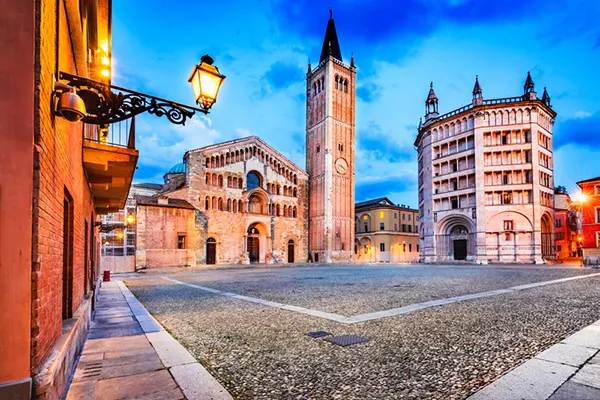
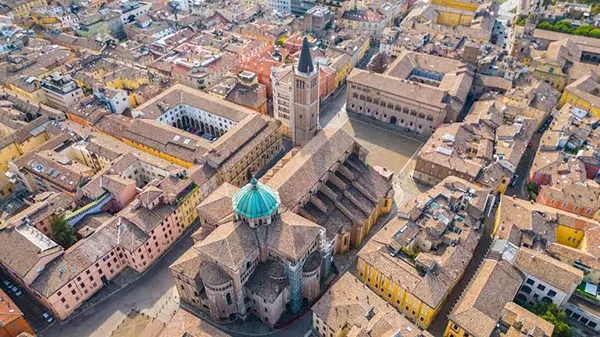
Piazza Duomo is the best place to start because it concentrates three layers of Parma’s history in one small square: the Cathedral of Santa Maria Assunta, the octagonal Baptistery and the Bishop’s Palace. The Cathedral is one of northern Italy’s important Romanesque churches, rebuilt after the earthquake of 1117 and later enriched with Renaissance painting. Its most famous work is Correggio’s Assumption of the Virgin in the dome, completed in the 1520s, where figures appear to rise through rings of clouds above the crossing. Lower down, Benedetto Antelami’s Deposition relief of 1178 provides a very different visual language: firm outlines, controlled gesture and a strong sense of narrative. In 2026 the Cathedral remains free for individual visitors and opens from early morning, which makes it useful for anyone trying to see a major monument before the day settles into its busier rhythm.
The Baptistery deserves more than a quick look from the square. Begun in 1196 and closely associated with Benedetto Antelami, it is faced with pink Verona marble and covered with sculpture that links biblical themes, medieval ideas about nature and the cycle of the months. The interior is compact, so the effect comes from looking carefully at the relationship between architecture, sculpture and painted decoration rather than trying to move quickly through a large building. In 2026 the Baptistery and Diocesan Museum are open daily from 10.00 to 18.00, while visits can be paused during religious services. A combined visiting pass is valid for two days, which is useful if you prefer to separate the square from the rest of the day instead of fitting everything into one continuous block.
From Piazza Duomo, continue behind the Cathedral to San Giovanni Evangelista, another key Correggio site, then return through Via Cavour towards the Pilotta. The distances are short enough that there is little reason to use public transport within this part of the centre. The route also makes sense historically: medieval religious Parma gives way to the civic and dynastic spaces associated with the Farnese rulers. If you arrive by train, the official tourist route estimates roughly ten minutes on foot to the historic centre, so even a day visitor can begin without a transfer. What matters more is the order. The Cathedral works well early, the Baptistery from 10.00, and the Pilotta from 9.00, giving you several ways to stagger the main interiors instead of reaching each one at the same time as organised groups.
A practical art route from Piazza Duomo to the Pilotta
The Complesso Monumentale della Pilotta is the one place in central Parma where it is easy to spend half a day without noticing the time. The complex includes the National Gallery, Farnese Theatre, National Archaeological Museum, Palatine Library and Bodoni Museum. In 2026 it is normally open Tuesday to Sunday from 9.00 to 19.00, with last admission at 18.00, and there are no fixed time slots for general admission. The National Gallery is particularly strong for anyone who wants to connect Parma’s churches with its museum collections, since works by Correggio and Parmigianino sit within a broader survey of Emilian, Lombard, Venetian and Tuscan painting. The wooden Farnese Theatre, built in the seventeenth century, is a completely different kind of stop and gives the visit a useful change of pace after a sequence of paintings.
If avoiding the busiest periods matters more than saving on admission, think carefully before choosing the first Sunday of the month. Parma takes part in the national free-museum initiative, and the Pilotta uses a special 2026 itinerary on those days, with some sections operating on reduced hours. A normal midweek visit is usually easier to plan because the standard timetable applies and you can spread the galleries across the late morning or afternoon. Another useful 2026 detail is that the north galleries open at 10.30, so arriving at 9.00 does not mean every section is immediately available. Starting with the Farnese Theatre or another open area and moving into the painting galleries later is a more efficient way to use the first part of the morning.
One important change affects older Parma itineraries: the Camera di San Paolo, famous for Correggio’s frescoed chamber in the former convent, closed on 31 August 2026 and is scheduled to remain closed until spring 2027 for safety and conservation work. It should therefore not be treated as an available stop for an autumn or winter 2026 trip. A practical substitute is the Pinacoteca Stuard, a civic gallery with a broad collection and a central location, or a visit to Teatro Regio. The theatre runs short guided visits on most days outside its annual closure period and allows visitors to see spaces such as the foyer, auditorium and Ridotto, subject to rehearsals and performances. This is a good example of why a current Parma route needs to be built around what is actually open rather than copied from an older weekend guide.
Read the historic centre as a lived-in city
Parma’s historic centre makes more sense when you walk through it continuously instead of treating each square as an isolated attraction. From the Pilotta, cross Piazzale della Pace and follow Strada Garibaldi towards Teatro Regio, then continue to the Basilica of Santa Maria della Steccata. The theatre, commissioned by Maria Luigia and opened in 1829, is a reminder of the city’s long association with opera, while the Steccata contains work by Parmigianino and the ducal burial chapel. From there, Piazza Garibaldi is only a short walk away. The square occupies a central position in everyday city life, and the surrounding streets make a useful point at which to slow down, have a coffee or decide whether to continue towards Via Farini, Piazza Ghiaia or the river. This compact layout is one of Parma’s practical advantages: changing the order of a visit rarely creates a large detour.
Via Farini is especially useful because it links the visual character of the centre with its food culture. The street is lined with bars, restaurants and specialist food shops, but it also works simply as a route between Piazza Garibaldi and the southern part of the old town. Nearby streets such as Borgo Giacomo Tommasini and Via Nazario Sauro are worth including because they show a less monumental Parma of small façades, courtyards, local businesses and evening activity. Piazza Ghiaia, north-west of Piazza Garibaldi, adds another layer. Weekly markets are held in this area on Wednesday and Saturday mornings, with stalls also extending towards Piazzale della Pace. If your visit falls on one of those days, the market can be treated as part of the walk rather than a separate attraction, especially if you want to see how the centre functions beyond museums and churches.
The best way to keep this part of the day comfortable is to leave some streets unscheduled. Parma does not require constant advance booking in the way that larger Italian art cities often do, and many of its most useful transitions happen in public space: Piazza Duomo to Via Cavour, the Pilotta to Piazza Garibaldi, Via Farini to the river. That gives you room to adjust if a church is temporarily closed for a service or if a museum visit takes longer than expected. It also prevents the day from becoming a sequence of interiors. The centre is flat and largely suited to walking, so a two- or three-hour loop can include medieval architecture, nineteenth-century theatre, shopping streets and a market without covering a large physical distance. Comfortable shoes matter more than a tightly timed transport plan.
Cross the river for Oltretorrente and a slower afternoon
Oltretorrente begins on the opposite side of the Parma stream and has a different atmosphere from the streets around Piazza Garibaldi. Historically, the district developed as a densely inhabited quarter beyond the old centre and became associated with artisans, migrants, religious institutions and working-class political life. Today, Via Massimo d’Azeglio, Via Imbriani, Piazzale Inzani and Piazzale Picelli form the backbone of a neighbourhood that is lively without feeling arranged primarily for visitors. The walk across the river is short, but the change in scale is noticeable: fewer monumental façades, more neighbourhood bars and shops, and a stronger sense that people are using the streets for ordinary daily routines. For a trip built around lower-pressure sightseeing, this is where Parma becomes most convincing.
One of the most relevant cultural stops here is the birthplace and museum of conductor Arturo Toscanini. The house is smaller and more personal than the Pilotta, with material connected to Toscanini’s life and musical career, and it fits naturally into an Oltretorrente walk. In the standard 2026 schedule it opens from Wednesday to Sunday and closes on Monday and Tuesday, although summer hours are reduced. From the museum you can continue through the district rather than turning back immediately towards the main monuments. Piazzale Picelli and the surrounding lanes are good places to stop for a drink, while Via Imbriani often feels more local than the better-known streets east of the river. This part of the route works particularly well in the late afternoon, when museum pressure is lower and the neighbourhood begins to fill for aperitivo.
Finish the walk by entering Parco Ducale, the large green space on the western side of the river. The park provides a calm link back towards the Pilotta area and station, so it is more useful as part of a route than as a separate destination. If you have already spent several hours in churches and galleries, this final section gives the day some physical space and keeps you from retracing the same streets. It also shows how close Parma’s different identities sit to one another: ducal architecture, a working neighbourhood, opera culture and food shops are all within a compact walking radius. Travellers staying overnight can then return to Via Farini, Oltretorrente or the streets around Piazza Garibaldi for dinner without needing to build a second transport plan.
Turn local food into a route rather than a single meal
Parma’s food reputation is unusually specific, which makes it worth planning a sequence of tastes rather than simply booking one expensive dinner. The city is recognised by UNESCO as a Creative City of Gastronomy, while the surrounding province is tied to protected products including Prosciutto di Parma DOP, Parmigiano Reggiano DOP, Culatello di Zibello DOP, Coppa di Parma IGP, Salame Felino IGP and Fungo di Borgotaro IGP. In the centre, start with a salumeria or specialist shop where cured meats and cheese can be tasted in small portions. Via Farini is a practical area for this: the official tourism site lists La Prosciutteria di Silvano Romani at number 9/c, with Parma ham, Parmigiano Reggiano in different ageing stages and several local cured meats. Another listed option is Antica Salumeria Rastelli on Strada della Repubblica, which also sells fresh pasta and regional products.
For a first proper meal, look beyond a generic board of ham and cheese. Torta fritta, small pieces of fried dough served with cured meats, is a classic starting point. Tortelli d’erbetta are filled with herbs, ricotta and Parmigiano Reggiano and are closely associated with Parma, while anolini are small filled pasta traditionally served in broth and are especially common in colder months and festive meals. Meat dishes can include rosa di Parma, a rolled roast combining beef with local ham and cheese, as well as less familiar preparations such as cavallo pesto, finely chopped raw horse meat seasoned in the local style. Not every visitor will want the latter, but its presence on traditional menus is a reminder that Parma’s cooking is broader than the two internationally famous products printed on souvenirs.
Wine helps place the meal in its regional setting. Colli di Parma DOC covers wines from the hills south of the city, including styles based on Malvasia and other local or regional grapes, while Lambrusco is also commonly paired with cured meats and rich pasta dishes. The sensible approach is to choose a few products with a clear local link rather than trying to order every speciality in one sitting. A light tasting around Via Farini at midday, fresh pasta later, and a more substantial dinner in Oltretorrente creates a food route that mirrors the walking route through the city. It also avoids the common mistake of spending the entire afternoon recovering from a large lunch when the Cathedral, galleries and historic streets are still open.
Add the Parma hills only if you have a second day
The city centre is enough for one full day, but the food story becomes much clearer if you have time to leave Parma itself. The official Strada del Prosciutto e dei Vini runs through the foothills and valleys south of the city, linking places such as Collecchio, Sala Baganza, Felino, Torrechiara, Langhirano, Traversetolo and Montechiarugolo. This is the territory associated not only with Prosciutto di Parma and Parmigiano Reggiano but also with Salame Felino, Colli di Parma wines and the black truffle of Fragno. The complete route is not realistic as a quick side trip; the tourism office suggests that including parks, castles and museums can turn it into an itinerary of roughly three days. For a two-day city break, choose one small area rather than trying to cover the whole province.
Langhirano is the logical direction for visitors whose main interest is Prosciutto di Parma, while Felino is closely linked to its salame and Torrechiara adds one of the province’s best-known castles to the same southern route. Visits to producers are more useful when booked in advance because working dairies and ham facilities operate to production schedules, not simply as visitor attractions. A guided food-valley outing can also remove the need to coordinate rural transport and tasting times yourself. If you prefer to remain independent, arrange one producer visit, one village or castle and lunch, then return to Parma in the afternoon. That keeps the second day focused and avoids spending more time in a car than at the places you came to see.
For travellers with only one day and no car, there is no need to regard the countryside as essential. Parma’s centre already gives a credible introduction to its food culture through salumerie, fresh pasta, markets and restaurants that serve local recipes. The strongest one-day sequence is straightforward: Cathedral early, Baptistery after it opens, Pilotta before or after lunch, a continuous walk through Piazza Garibaldi and Via Farini, then Oltretorrente for the late afternoon and dinner. Check current religious-service times and museum notices on the day, especially because the Camera di San Paolo remains closed from 31 August 2026 until spring 2027. With that adjustment, Parma in 2026 is a city where art, streets and food can be connected in a single walk without turning the visit into a race from one queue to the next.